

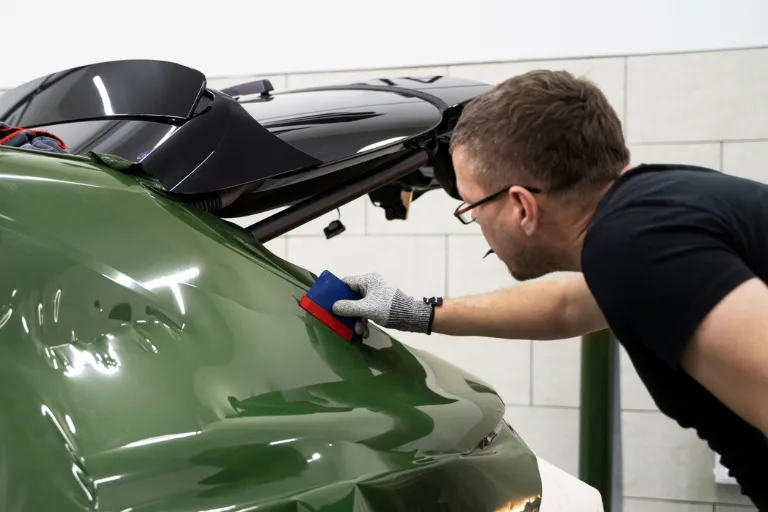
Protecting a vehicle’s paint has become an important part of modern automotive detailing.
As vehicle prices increase and owners become more conscious about maintaining appearance and resale condition, two protection systems are frequently discussed:
Paint Protection Film (PPF) and Ceramic Coating.
Both can provide valuable protection, but they do not do the same job.
This is one of the most common areas of confusion for car owners. Someone may ask, “Should I get PPF or ceramic coating?” as if they are competing products designed to solve exactly the same problem.
They are not.
PPF is a physical film applied over the vehicle’s paint. Its major strength is protecting the underlying surface from physical impacts and certain types of damage.
Ceramic coating is a liquid-applied protective layer that bonds to the prepared surface. It is particularly valued for gloss, hydrophobic behaviour, easier maintenance and protection against certain environmental contaminants.
The right choice therefore depends on what the owner is trying to protect against.
In some situations, PPF makes more sense.
In others, ceramic coating may be sufficient.
And for owners seeking a more comprehensive protection strategy, PPF and ceramic coating can potentially be used together.
What Is Paint Protection Film?
Paint Protection Film, commonly called PPF, is a transparent protective film installed over selected painted surfaces of a vehicle.
The primary purpose is to create a physical barrier between the paint and external hazards.
Depending on the film and installation system, PPF can help protect against:
- Stone chips
- Road debris
- Light scratches
- Surface abrasions
- Bug impacts
- Road grime
- Certain environmental contaminants
PPF is particularly valuable on areas that receive significant physical exposure.
Common applications include:
- Front bumper
- Bonnet
- Fenders
- Side mirrors
- Door edges
- Rocker panels
- Door cups
- Other high-impact areas
Full-vehicle installation is also an option for owners who want broader protection.
What Is Ceramic Coating?
Ceramic coating is a liquid-applied protective product that is professionally installed over a properly prepared vehicle surface.
Once cured, it creates a protective layer over the paint.
Depending on the product and system, ceramic coatings can provide benefits such as:
- Hydrophobic behaviour
- Enhanced gloss
- Easier cleaning
- Improved resistance to certain contaminants
- Surface protection
- Better visual depth
Ceramic coatings are not designed to function like a thick physical film.
They are therefore not a direct substitute for PPF when the primary concern is impact protection from road debris.
The Biggest Difference: Physical Protection vs Surface Protection
The easiest way to understand the difference is this:
PPF = Physical Barrier
Ceramic Coating = Protective Surface Layer
PPF physically sits between the outside environment and the painted surface.
Ceramic coating creates a thin protective layer over the paint.
This difference determines how each system behaves when exposed to different types of hazards.
PPF Is Designed for Impact Protection
Imagine driving on a highway behind a vehicle that throws a small stone toward your car.
The impact can chip the paint.
A ceramic coating is not designed to absorb that type of physical impact.
PPF, however, can provide a physical protective layer between the impact and the underlying paint.
This is one of the major reasons owners choose PPF for high-impact areas.
For vehicles frequently driven on highways or roads with significant debris, this distinction can be particularly important.
Ceramic Coating Is Strong on Hydrophobic Performance
One of the most noticeable characteristics of a ceramic coating is its water-repellent behaviour.
A quality coating can make water form tighter beads and can help reduce the tendency of certain contaminants to bond strongly to the surface.
This can make the vehicle easier to maintain.
However, hydrophobic behaviour should not be confused with complete protection from contamination.
The vehicle still needs proper washing and maintenance.
PPF and Ceramic Coating Protect Against Different Problems
Consider a few common situations.
| Situation | More Relevant Protection |
| Stone chips | PPF |
| Road debris | PPF |
| Physical impact | PPF |
| Light surface abrasion | PPF can be useful |
| Hydrophobic behaviour | Ceramic coating |
| Gloss enhancement | Ceramic coating |
| Easier maintenance | Ceramic coating |
| Environmental contamination | Ceramic coating can help |
| High-impact front end | PPF |
| Overall surface maintenance | Ceramic coating |
The exact performance depends on the specific product, installation quality and environmental conditions.
Does PPF Prevent Scratches?
PPF can provide a physical layer that helps protect paint against certain scratches and abrasions.
Some modern films also have self-healing properties for suitable light surface marks when the film is exposed to appropriate heat conditions, depending on the product.
However, PPF is not indestructible.
Severe impacts can still damage the film.
The benefit is that the film can take damage that might otherwise have affected the vehicle’s original paint.
Does Ceramic Coating Prevent Scratches?
This is an area where expectations need to be realistic.
Ceramic coating is sometimes marketed in ways that can make owners believe it creates a scratch-proof surface.
It does not.
A ceramic coating may provide some surface-level resistance and protection against certain contaminants, but it should not be treated as an impact-resistant film.
If physical impact and stone-chip protection are major priorities, PPF is generally the more relevant technology.
Gloss and Appearance
Ceramic coating is often selected because of the visual finish it can provide.
A properly prepared and coated vehicle can have:
- High gloss
- Improved clarity
- Enhanced paint depth
- Stronger water behaviour
However, it is important to remember that coating quality depends heavily on paint preparation.
If the paint contains swirl marks, scratches or other defects, the coating will not automatically remove them.
The preparation underneath matters.
PPF Can Also Improve Appearance
Modern PPF is not simply about protection.
Depending on the film, it can provide:
- High gloss
- A smooth appearance
- Hydrophobic characteristics
- A consistent finish
Some films are designed to closely match the appearance of the original paint while providing physical protection.
The quality of installation also matters significantly.
Poor installation can affect the visual result.
Why Installation Quality Matters
A high-quality protection product can still produce a poor result if it is incorrectly installed.
For PPF, installation quality can affect:
- Alignment
- Edges
- Seams
- Contamination
- Stretching
- Film placement
- Overall appearance
For ceramic coating, application quality can affect:
- Coverage
- High spots
- Streaking
- Curing
- Uniformity
Therefore, choosing the product is only one part of the decision.
The installer and process matter too.
PPF Requires a Strong Preparation Process
Before PPF installation, the surface should be properly prepared.
Depending on the vehicle, preparation may involve:
- Thorough washing
- Decontamination
- Paint inspection
- Paint correction where required
- Surface preparation
- Film installation
- Edge finishing
- Final inspection
Applying PPF over poorly prepared paint can potentially lock existing imperfections underneath the film.
For this reason, professional inspection before installation is extremely important.
Ceramic Coating Also Requires Paint Preparation
Ceramic coating has its own preparation requirements.
The vehicle may require:
- Washing
- Decontamination
- Paint inspection
- Polishing
- Paint correction
- Surface preparation
- Final inspection
Any polishing oils or residues should be properly removed before coating according to the product’s application requirements.
The better the surface preparation, the better the foundation for the coating.
Which One Is Better for a New Car?
A new car does not automatically mean it needs no preparation.
Even a newly delivered vehicle can have:
- Transport contamination
- Dealer-installed marks
- Light washing defects
- Adhesive residue
- Minor imperfections
The vehicle should therefore be inspected before protection is installed.
For a new vehicle, the decision can then be based on how the owner plans to use it.
If the vehicle is a daily highway driver, PPF may provide significant value.
If the main priority is gloss and easy maintenance, ceramic coating may be attractive.
If both matter, combining the systems can be considered.
Which One Is Better for a Daily Driver?
A daily driver is exposed to a wide variety of conditions.
These may include:
- Traffic
- Dust
- Road debris
- Parking environments
- Weather
- Pollution
- Frequent washing
The right protection therefore depends on the most significant risks.
For example, an owner who drives long highway distances may place greater value on PPF.
Another owner who mostly drives in urban conditions and prioritises easy cleaning may place greater emphasis on ceramic coating.
There is no universal answer.
Can You Have PPF and Ceramic Coating Together?
Yes, these systems can complement each other when compatible products and processes are used.
A common strategy is:
PPF on high-impact areas + Ceramic coating over the vehicle or compatible protected surfaces
The PPF provides a physical protective layer.
The ceramic coating can provide hydrophobic behaviour, gloss and easier maintenance.
Some coating products are specifically designed for use on PPF.
The product manufacturer’s compatibility and application instructions should always be followed.
A Common Protection Strategy
For a premium vehicle, an owner might choose:
High-Impact Areas
PPF on:
- Front bumper
- Bonnet
- Fenders
- Mirrors
- Rocker panels
Remaining Paint
Ceramic coating across suitable painted surfaces.
This creates a combination of physical protection and surface protection.
The exact coverage should be determined based on vehicle usage, budget, priorities and the specific protection products being used.
What About Full-Car PPF?
Full-car PPF provides broader physical protection.
It may be attractive for:
- High-value vehicles
- New luxury vehicles
- Enthusiast cars
- Performance vehicles
- Vehicles driven extensively on highways
- Owners who want maximum paint protection
The decision should still consider:
- Cost
- Ownership period
- Driving conditions
- Vehicle value
- Installation quality
- Maintenance
- Personal priorities
More coverage is not automatically necessary for every owner.
What About Only Ceramic Coating?
Ceramic coating can make sense when the owner’s primary goals are:
- Gloss
- Hydrophobic performance
- Easier maintenance
- Environmental protection
- A premium finish
It may be a practical choice for owners who understand that it is not a substitute for physical impact protection.
A well-prepared and properly coated vehicle can still look excellent and be easier to maintain.
Common Mistakes When Choosing Between PPF and Ceramic Coating
1. Thinking They Are the Same Product
They serve different purposes.
2. Choosing Based Only on Price
The cheapest option may not provide the protection the vehicle actually needs.
3. Expecting Ceramic Coating to Stop Stone Chips
Ceramic coating is not designed to function as an impact-resistant film.
4. Assuming PPF Makes a Vehicle Maintenance-Free
PPF still needs proper cleaning and care.
5. Ignoring Installation Quality
The product cannot compensate for poor installation.
6. Skipping Paint Preparation
Both systems benefit from proper surface preparation.
7. Believing More Protection Is Always Better
The correct protection depends on vehicle usage and customer priorities.
How to Choose the Right Protection
Before making a decision, ask these questions.
How Do You Drive?
Mostly city driving or frequent highway travel?
What Is Your Main Concern?
Stone chips, scratches, gloss, contamination or easier maintenance?
How Long Will You Keep the Vehicle?
A longer ownership period can change the value calculation.
What Is the Vehicle’s Value?
Higher-value vehicles may justify a more comprehensive protection strategy for some owners.
What Is Your Budget?
Protection should fit both the vehicle and the owner’s realistic budget.
How Much Maintenance Are You Comfortable With?
Different systems require different maintenance expectations.
PPF vs Ceramic Coating: Quick Comparison
| Feature | PPF | Ceramic Coating |
| Physical impact protection | Stronger role | Limited |
| Stone-chip protection | Yes, primary benefit | Not designed for this |
| Scratch protection | Better suited to physical protection | Limited surface resistance |
| Hydrophobic behaviour | Depends on film | Major benefit |
| Gloss | Can provide high gloss | Strong visual enhancement |
| Paint protection | Physical barrier | Protective surface layer |
| Easier cleaning | Can help | Major benefit |
| Thickness | Physical film | Thin coating layer |
| Installation | Film installation | Liquid application |
| High-impact areas | Excellent application | Not a substitute |
| Long-term maintenance | Still required | Still required |
| Can be combined | Yes | Yes, with compatible products |
The Right Question Is Not “PPF or Ceramic?”
Instead of asking:
“Which one is better?”
ask:
“What type of protection does my vehicle actually need?”
If physical impact is the biggest concern, PPF may be the more relevant solution.
If gloss, hydrophobic behaviour and easier maintenance are the priorities, ceramic coating may be more appropriate.
If the owner wants both types of benefits, a combination strategy can be considered.
Final Thoughts
PPF and ceramic coating are both valuable automotive protection systems, but they should not be treated as interchangeable products.
PPF is primarily a physical protective barrier, making it particularly relevant for stone chips, road debris and certain forms of physical damage.