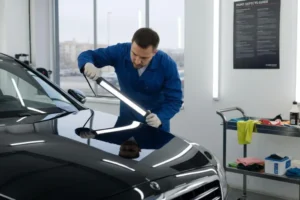

How to Choose the Right Compound for Paint Correction
Paint correction is one of the most technical services in professional automotive detailing. The objective is not simply to make a vehicle look glossy. It involves carefully improving the appearance of the paint by reducing or removing suitable surface defects while maintaining an appropriate level of paint safety.
One of the most important decisions during the process is choosing the right compound for paint correction.
There are countless compounds available, ranging from heavy-cutting products designed for significant defect removal to finishing compounds designed to refine the surface and improve clarity.
However, stronger does not always mean better.
The correct compound depends on the condition of the paint, the severity of the defects, the type of paint, the pad being used, the polishing machine, and the result the technician is trying to achieve.
A professional approach therefore starts with inspection and testing, rather than automatically choosing the most aggressive compound.
What Does a Paint Correction Compound Do?
A paint correction compound contains abrasive technology designed to reduce or remove suitable paint defects through controlled machine polishing.
Depending on the product, the compound may be designed for:
- Heavy defect removal
- Medium correction
- One-step correction
- Finishing and refinement
The abrasive system interacts with the pad and the paint surface.
The final level of correction is therefore not determined by the compound alone.
It is influenced by the complete combination of:
Compound + Pad + Machine + Technique + Paint Condition
This is why two technicians can use the same compound and achieve different results.
Start With Paint Inspection
Before selecting a compound, the technician should inspect the vehicle carefully.
Common paint defects include:
- Swirl marks
- Fine scratches
- Oxidation
- Water spots
- Holograms
- Bird-dropping etching
- Random isolated scratches
- Previous polishing marks
The technician should also look for evidence of previous paintwork or repairs.
A vehicle that has been repainted may respond differently from original factory paint.
This inspection provides the starting point for selecting an appropriate correction strategy.
Not Every Defect Requires Heavy Cutting
One of the most common mistakes in paint correction is using an aggressive compound when the paint does not require it.
If the defects are relatively light, a heavy-cut compound may remove more material than necessary and create additional finishing work.
A less aggressive combination may provide an appropriate improvement while preserving more of the existing paint.
The principle is straightforward:
Use the least aggressive method that can reasonably achieve the desired result.
This does not mean avoiding stronger compounds.
Heavy-cut products have an important role when the condition of the paint requires them.
The key is to use them intentionally.
Understanding Compound Categories
Compounds can broadly be considered in several categories.
Heavy-Cutting Compounds
These are designed for more significant defect removal.
They may be appropriate for deeper defects, severe oxidation, or heavily marked surfaces where substantial correction is required.
However, they can require additional refinement afterward.
Medium-Cut Compounds
These provide a balance between correction and finish.
They can be useful for moderate defects and certain one-step correction processes depending on the paint and desired result.
Finishing Compounds
These are generally designed for refinement, gloss, clarity, and removal of lighter polishing marks.
They may be suitable when the paint is already in relatively good condition.
The actual performance of a product depends on its formulation and the complete polishing system being used.
Pad Selection Changes the Result
The compound cannot be evaluated independently from the pad.
The pad contributes significantly to the level of correction and finish.
For example, the same compound can behave differently when paired with:
- A microfiber cutting pad
- A foam cutting pad
- A polishing foam pad
- A finishing pad
The technician should select the pad based on the required level of correction and the behaviour of the paint.
This is why experienced detailers often test different combinations before committing to a complete vehicle.
Machine Type Also Matters
The polishing machine influences how the compound and pad interact with the paint.
Dual-action polishers and rotary machines have different operating characteristics.
A dual-action machine can provide controlled correction and is widely used across professional detailing applications.
Rotary machines can provide strong cutting capability but require appropriate technician skill and control.
The machine should therefore be selected according to:
- Paint condition
- Correction requirements
- Technician experience
- Panel characteristics
- Desired finish
The machine is a tool. The technician’s understanding of how to use it remains essential.
The Test Spot Is One of the Most Important Steps
Instead of immediately polishing the entire vehicle, a professional technician can perform a test spot on a representative area.
This small section helps determine:
- How the paint responds
- How much correction is possible
- Whether the compound is appropriate
- Whether the pad needs to change
- Whether multiple passes are required
- Whether additional finishing is necessary
For example, a technician may start with a moderate compound and polishing pad.
If the correction is insufficient, the process can be adjusted.
This approach reduces guesswork and helps avoid unnecessary aggression.
Paint Hardness Can Affect Compound Choice
Different automotive paints can respond differently to polishing.
Some surfaces may correct relatively easily.
Others may be more resistant and require a different combination of compound, pad, machine, and technique.
The technician should therefore avoid assuming that one product combination will work on every vehicle.
Paint behaviour should be evaluated during the test process.
This is another reason professional paint correction is a technical service rather than a simple product-application procedure.
Deeper Scratches Require Careful Evaluation
Not every scratch should be completely removed.
Some defects may extend deeper into the paint system.
Attempting to remove every visible scratch can require excessive correction and may compromise the available paint thickness.
The technician should consider:
- Defect depth
- Paint thickness
- Surrounding paint condition
- Expected improvement
- Safety of further correction
In some cases, reducing the visual appearance of a defect may be a more appropriate objective than pursuing complete removal.
A professional result is not necessarily the result with the most aggressive correction.
It is the result that balances appearance improvement with paint preservation.
One-Step Correction Requires the Right Balance
One-step polishing has become popular because it can provide meaningful improvement within a relatively efficient workflow.
The challenge is balancing correction and finishing.
A compound and pad combination may remove a significant amount of defects while leaving a refined finish.
However, one-step correction will not necessarily provide the same level of defect removal as a multi-stage correction process.
The appropriate approach depends on:
- Vehicle condition
- Paint characteristics
- Customer expectations
- Available service time
- Desired finish
Clear communication is important so customers understand what the selected process can realistically achieve.
More Aggressive Does Not Always Mean Better
It is tempting to believe that the strongest compound will always produce the best result.
In reality, aggressive correction can create additional challenges.
It may produce:
- Additional polishing marks
- Haze
- Micro-marring
- Increased finishing requirements
- Greater paint removal
A professional technician should therefore focus on controlled correction, not maximum correction at any cost.
The goal is to improve the surface intelligently.
Environmental Conditions Can Influence the Process
The working environment can also affect polishing.
Temperature, humidity, panel temperature, ventilation, and product behaviour can influence how a compound works.
A controlled detailing environment makes it easier for technicians to maintain consistent working conditions.
This is particularly important when performing complex correction work or preparing a vehicle for a protective coating.
Technique Is as Important as the Compound
Even the correct compound can produce inconsistent results if the technician’s technique is poor.
Important factors include:
- Machine speed
- Arm movement
- Pressure
- Working area size
- Number of passes
- Pad condition
- Compound quantity
- Panel temperature
- Inspection between stages
Technicians should also clean or replace pads appropriately during the process.
A saturated or contaminated pad may behave differently from a clean pad.
Inspect the Result Before Moving Forward
After polishing a test area or panel, the technician should inspect the result under appropriate lighting.
The inspection should determine:
Did the defects improve?
Is the finish acceptable?
Is additional correction necessary?
Has the process created new marks?
Is further correction appropriate?
This feedback loop helps technicians refine their approach.
Professional paint correction is therefore a continuous process of inspect → test → correct → inspect.
Choosing Compound Based on the Desired Outcome
The customer’s objective should also influence the compound selection.
A customer preparing a daily driver for improved appearance may want a balanced improvement without extensive correction.
A collector vehicle may require a more detailed correction process.
A vehicle being prepared for ceramic coating may need appropriate refinement and surface preparation.
The service recommendation should therefore be based on the vehicle’s condition and the customer’s expectations rather than simply selecting a product from a shelf.
Avoid Product-Driven Detailing
A professional detailing studio should avoid allowing product availability to determine the correction process.
Instead of asking:
“Which compound do we have?”
The better question is:
“What does this paint require?”
Once the requirement is understood, the technician can select an appropriate combination.
This mindset creates a more controlled and professional approach to detailing.
A Practical Compound Selection Process
A simple workflow can help technicians make better decisions.
Step 1 — Inspect the Vehicle
Identify defects and overall paint condition.
Step 2 — Measure Where Appropriate
Use suitable inspection tools, such as a paint thickness gauge, when required.
Step 3 — Define the Desired Result
Understand the customer’s expectations.
Step 4 — Start With a Reasonable Combination
Select an appropriate compound and pad combination.
Step 5 — Perform a Test Spot
Evaluate correction and finish.
Step 6 — Adjust if Required
Change the compound, pad, machine, or technique based on the result.
Step 7 — Apply the Proven Process
Once the combination is validated, proceed across the appropriate areas.
Step 8 — Perform Final Inspection
Check the finished surface before protection or delivery.
This systematic approach reduces guesswork and supports consistent results.
The Importance of Technician Experience
Product knowledge is useful, but experience becomes particularly valuable when paint behaves unexpectedly.
An experienced technician can recognize when:
- A combination is too aggressive
- A pad is becoming saturated
- The paint is generating excessive heat
- Correction has reached an appropriate level
- Further polishing may create unnecessary risk
- Additional refinement is required
This practical judgment is one of the key differences between professional detailing and simple product application.