Why Process Matters More Than Just Product in Automotive Detailing
The automotive detailing industry has never had more products available.
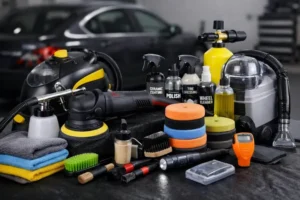
From advanced compounds and polishes to ceramic coatings, graphene products, specialty cleaners, microfiber towels, polishing pads, and Paint Protection Film, today’s detailing professionals have access to an impressive range of products designed to improve vehicle appearance and protection.
But there is an important question that often gets overlooked:
Does the product create the result, or does the process?
In professional automotive detailing, the product is only one part of the equation.
The quality of the final result depends heavily on how the vehicle is inspected, prepared, treated, corrected, protected, and inspected again.
A premium product used incorrectly may deliver an average result. A suitable product used with the correct process can often deliver a significantly better and more consistent outcome.
This is why understanding the detailing process is fundamental to professional automotive care.
A Product Cannot Replace a Proper Process
It is easy to focus on products because they are visible and easy to market.
A detailing business can talk about the brand of coating, compound, shampoo, or polish being used. Customers can compare product specifications and read claims about durability, gloss, protection, or performance.
However, the product is only as effective as the process surrounding it.
Consider a ceramic coating.
The coating itself may have excellent technical characteristics, but if the vehicle is not properly washed, decontaminated, polished, and prepared before application, the final result may not meet expectations.
The same principle applies to paint correction.
A high-performance polishing compound cannot compensate for:
- Incorrect pad selection
- Excessive pressure
- Poor machine control
- Incorrect working speed
- Inadequate inspection
- Improper surface preparation
Professional detailing is therefore not simply about finding the best product.
It is about using the right product in the right situation through the right process.
Inspection Comes Before Action
One of the most important stages of a professional detailing process is vehicle inspection.
Before selecting products or starting correction work, the technician should understand the condition of the vehicle.
The inspection can identify:
- Swirl marks
- Scratches
- Water spots
- Oxidation
- Paint contamination
- Previous repairs
- Existing coatings
- Interior damage
- Surface-specific concerns
Every vehicle is different.
Two black cars may look similar from a distance but have completely different paint conditions.
One may require a light finishing polish, while another may require a more intensive correction process.
Without proper inspection, technicians may use an unnecessarily aggressive process or fail to address the actual problem.
Preparation Determines the Starting Point
Preparation is another area where professional detailing differs from basic vehicle cleaning.
Before polishing or applying protection, the surface needs to be appropriately prepared.
Depending on the service, preparation may include:
- Pre-wash
- Foam application
- Safe contact washing
- Chemical decontamination
- Mechanical decontamination
- Drying
- Surface inspection
- Masking
- Paint correction or refinement
- Final surface preparation
Skipping preparation can compromise everything that follows.
A coating applied to a poorly prepared surface cannot deliver the same result as one applied to a properly prepared surface.
Technique Matters During Paint Correction
Paint correction is one of the clearest examples of why process matters more than product.
The technician needs to understand the relationship between:
Machine + Pad + Compound + Pressure + Speed + Technique + Paint Condition
Changing one element can change the result.
For example, a more aggressive pad and compound combination may remove defects faster, but it can also create additional finishing work.
A softer combination may produce a beautiful finish but may not provide enough correction for deeper defects.
The technician therefore needs to evaluate the paint and select an appropriate approach.
This is where experience and training become extremely valuable.
The Test Spot Reduces Guesswork
A professional detailing process should avoid unnecessary guesswork.
One useful approach is performing a test spot before committing to a complete paint correction strategy.
A small section can be used to evaluate:
- Defect removal
- Paint response
- Finish quality
- Product combination
- Number of passes required
The technician can then refine the process before applying it across the entire vehicle.
This can improve efficiency while reducing the possibility of using an unnecessarily aggressive approach.
Product Selection Should Follow the Process
Products should support the process rather than dictate it.
Instead of asking:
“Which is the strongest compound?”
A professional technician should ask:
“What does this paint actually need?”
The same principle applies to coatings and cleaners.
A product should be selected based on:
- Surface type
- Condition
- Desired outcome
- Compatibility
- Application requirements
- Environmental conditions
- Customer expectations
This approach creates a more professional and controlled workflow.
Application Conditions Matter
Even the right product can perform differently depending on application conditions.
Temperature, humidity, lighting, surface temperature, contamination, curing conditions, and working environment can all influence certain detailing processes.
This is especially important for coatings and other products with specific application requirements.
A professional studio should therefore understand the environment in which the product is being used.
This is another reason why a controlled detailing workspace can be valuable.
Skilled Technicians Create Consistency
Products can be purchased by almost anyone.
Professional technique takes time to develop.
A skilled technician understands how to read a surface and adapt the process accordingly.
Training should include more than product demonstrations.
Technicians should learn:
- Surface inspection
- Safe washing
- Decontamination
- Paint correction
- Machine operation
- Pad and compound selection
- Coating preparation
- Interior material identification
- Finishing techniques
- Quality inspection
The objective is to create technicians who understand why they are performing each step.
Quality Control Completes the Process
A detailing job should not be considered complete when the technician finishes the last application.
The vehicle needs to be inspected.
Quality control may involve checking:
- Paint finish
- Remaining defects
- Polishing residue
- Coating residue
- Edges
- Glass
- Wheels
- Interior surfaces
- Trim
- Missed areas
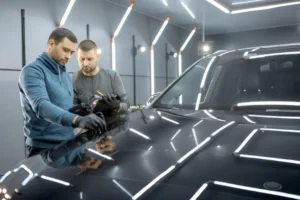
Professional inspection lighting can help identify imperfections that are difficult to see under normal lighting.
The final inspection is important because the customer should receive a vehicle that meets the agreed service standard—not simply a vehicle that looks good at first glance.
Different Services Require Different Processes
There is no single detailing process that works for every service.
Paint Correction
Focuses on defect removal and paint refinement.
Ceramic Coating
Requires thorough preparation and controlled application.
Paint Protection Film
Requires precise installation, surface preparation, positioning, and finishing.
Interior Detailing
Requires understanding of different materials such as leather, fabric, plastic, vinyl, and other surfaces.
Maintenance Detailing
Focuses on preserving previously achieved results while safely removing contamination.
Each service requires its own workflow.
This is why simply adding services to a price list does not automatically create professional capability.
Customer Expectations Are Part of the Process
Professional detailing is also about communication.
Customers should understand what the service can and cannot achieve.
For example, a deep scratch may not be completely removable without creating unnecessary risk to the paint.
Similarly, a ceramic coating provides protection and can make maintenance easier, but it does not make the vehicle completely scratch-proof.
Clear communication before the service helps prevent unrealistic expectations.
A professional detailing business should explain:
- Current vehicle condition
- Recommended service
- Expected outcome
- Limitations
- Approximate service time
- Maintenance requirements
This creates transparency and builds trust.
Documentation Improves Professionalism
Documentation can make the detailing process more controlled.
Before-and-after photographs can record the vehicle’s condition.
A digital job card can capture:
- Vehicle details
- Existing defects
- Customer requirements
- Selected services
- Work performed
- Products used
- Recommendations
This information can also help with future maintenance.
For premium vehicles, maintaining a service history can provide additional value to the customer.
Process Also Improves Business Efficiency
The benefits of a standardized detailing process are not limited to vehicle quality.
It can also improve business operations.
A defined process can help a studio understand:
- How long each service takes
- How many technicians are required
- Which products are consumed
- Where delays occur
- Where rework happens
- Which services generate the most operational effort
This information can help management improve scheduling, pricing, inventory planning, and technician productivity.
In other words, a strong detailing process can improve both service quality and business performance.
Standardization Does Not Mean Every Car Is Treated the Same
Standardization is sometimes misunderstood.
It does not mean using exactly the same products and techniques on every vehicle.
Instead, it means having a consistent decision-making framework.
For example:
Inspect → Identify → Test → Select Process → Execute → Inspect → Deliver
The specific products and techniques may change depending on the vehicle.
The framework remains consistent.
This provides flexibility without sacrificing control.
Building a Process-Driven Detailing Studio
A professional studio can build its operating system around several principles:
-
Inspect Before You Recommend
Understand the vehicle before suggesting a service.
-
Prepare Before You Correct
Create the right surface condition before beginning technical work.
-
Test Before You Scale
Validate the approach on a small area where appropriate.
-
Train Before You Delegate
Technicians need technical understanding before handling advanced services independently.
-
Inspect Before You Deliver
Final quality control should be part of the workflow.
-
Document Before You Close the Job
Maintain useful records for transparency and future maintenance.
These principles create a repeatable and professional operation.
The Product Is Important—But It Is Not Everything
None of this means products are unimportant.
Quality products matter.
The right compound can improve correction.
The right polish can improve finishing.
The right coating can provide appropriate protection.
The right cleaning chemical can improve efficiency.
The right PPF can provide valuable surface protection.
But products work within a larger system.
The difference between an average result and a professional result often comes from what happens before, during, and after the product is applied.