

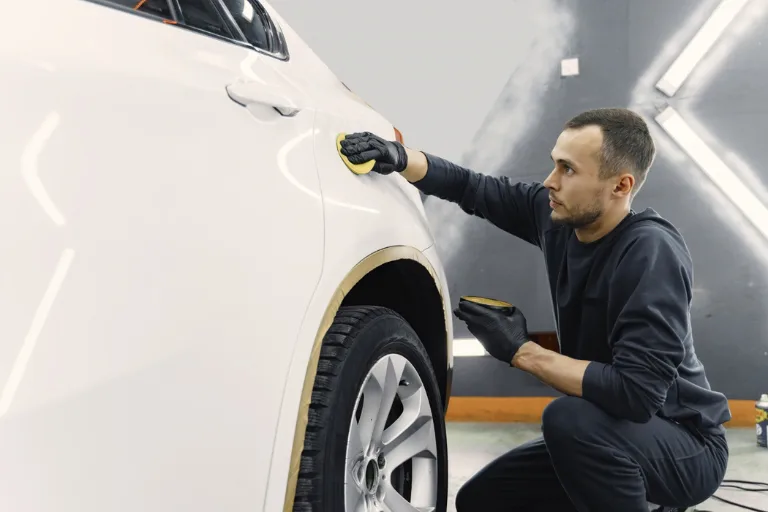
When a vehicle starts losing its gloss, develops swirl marks or shows visible surface imperfections, many car owners immediately assume that they need paint correction.
But that is not always the case.
Sometimes the vehicle does not require an aggressive correction process. It may simply need a carefully selected paint enhancement to improve gloss, refine the surface and create a cleaner overall appearance.
Understanding the difference between paint correction and paint enhancement is important because the two services have different objectives.
Paint correction generally focuses on reducing or removing paint defects through machine polishing and a carefully controlled process. Paint enhancement, on the other hand, typically focuses more on improving gloss, clarity and overall appearance while using a less aggressive approach.
The right choice depends on the vehicle’s paint condition, the customer’s expectations, the desired finish, the available paint thickness where relevant, and how much correction is actually necessary.
The goal should not always be maximum correction.
The goal should be the right result for the vehicle.
What Is Paint Correction?
Paint correction is a professional polishing process designed to reduce or remove visible defects from a vehicle’s paintwork.
Depending on the condition of the paint, these defects can include:
- Swirl marks
- Fine scratches
- Oxidation
- Holograms
- Water-spot etching
- Random isolated defects
- Dullness
- Wash-induced marring
The correction process usually involves machine polishing with an appropriate combination of:
- Compound
- Polish
- Pad
- Machine
- Technique
The exact combination depends on the paint condition and the desired result.
A professional detailer should not automatically begin with the most aggressive combination.
Instead, the paint should be inspected first.
What Is Paint Enhancement?
Paint enhancement is generally a less aggressive polishing approach focused on improving the overall appearance of the paint.
The objective is often to:
- Increase gloss
- Improve clarity
- Refine minor imperfections
- Enhance colour depth
- Improve the visual finish
It may be suitable when a vehicle has relatively good paint but has lost some of its gloss or developed light surface imperfections.
An enhancement process can sometimes deliver a significant visual improvement without attempting to remove every defect.
This can be particularly useful when the customer’s priority is a fresh, glossy and refined appearance rather than maximum defect removal.
Paint Correction vs Paint Enhancement: The Main Difference
The simplest way to understand the difference is to look at the primary objective.
Paint correction:
Focuses more heavily on defect reduction or removal.
Paint enhancement:
Focuses more heavily on gloss, clarity and visual refinement.
However, these are not completely separate worlds.
A professional detailer may use polishing techniques that fall somewhere between a basic enhancement and a multi-stage correction.
The appropriate process should be determined after inspecting the vehicle.
Why Vehicle Inspection Should Come First
Before recommending either service, the vehicle should be properly inspected.
Looking at the car under normal outdoor lighting may not reveal everything.
Professional inspection may involve:
- Proper washing
- Decontamination
- Strong inspection lighting
- Different viewing angles
- Close examination of panels
- Identification of paint defects
- Previous repair assessment
- Paint thickness measurement where appropriate
This process helps the detailer understand what is actually happening to the paint.
Without inspection, service selection can become guesswork.
Not Every Scratch Needs to Be Removed
One of the most important things for customers to understand is that not every visible defect should automatically be chased.
Some scratches may be too deep for safe removal through normal polishing.
If a defect extends deeply into the paint system, attempting to remove it completely may require removing too much material.
A professional detailer therefore needs to balance:
Correction level + Paint safety + Desired appearance
The objective is not to make every defect disappear regardless of risk.
The objective is to improve the finish responsibly.
When Paint Enhancement May Be the Better Choice
Paint enhancement may make sense when:
The Paint Is Already in Good Condition
If the vehicle has relatively well-maintained paint with only minor surface imperfections, a full correction process may not be necessary.
The Customer Wants More Gloss
Some customers primarily want their vehicle to look newer and more vibrant.
The Vehicle Is a Daily Driver
A daily-driven vehicle will naturally develop new marks over time.
For such vehicles, maximum correction may not always be the most practical approach.
The Customer Has a Limited Time Window
An enhancement process can sometimes be completed more efficiently than a multi-stage correction, depending on the vehicle.
The Customer Wants a Regular Maintenance Service
Paint enhancement can potentially form part of a periodic detailing strategy where the objective is to maintain appearance rather than repeatedly pursue maximum correction.
When Paint Correction May Be More Appropriate
Paint correction may be more suitable when:
- Swirl marks are clearly visible
- Paint has significant marring
- Previous polishing has left defects
- Oxidation is present
- The customer wants a higher level of defect reduction
- The vehicle is being prepared for a premium protection service
- The paint requires more extensive refinement
However, the exact correction level should still be determined after inspection.
A vehicle may require:
- One-step correction
- Two-step correction
- Multi-stage correction
- Localised correction
The service should be based on the actual condition of the paint.
One-Step Correction Can Be a Practical Middle Ground
There is often a middle ground between enhancement and extensive multi-stage correction.
A one-step correction can be designed to improve gloss while also reducing a meaningful amount of suitable surface defects.
The exact level of improvement depends on:
- Paint hardness
- Defect depth
- Compound
- Pad
- Machine
- Technician technique
- Number of passes
- Paint condition
A one-step process should therefore not be marketed as a guaranteed percentage of correction for every vehicle.
Different paints behave differently.
Paint Hardness Can Change the Result
Automotive paint is not identical across all vehicles.
Different manufacturers and paint systems can behave differently during machine polishing.
Some paint may respond relatively quickly to a particular combination.
Another vehicle may require more controlled refinement.
This is why experienced technicians do not simply apply the same process to every vehicle.
They observe how the paint responds.
The Test Spot Is One of the Most Important Steps
A professional test spot can provide valuable information before a complete correction begins.
A detailer can test a small area using a selected:
- Machine
- Pad
- Compound or polish
- Number of passes
- Technique
The result can then be inspected.
The test spot helps answer questions such as:
- Is the chosen combination effective?
- How much correction is achievable?
- Is the finish clear?
- Is additional refinement required?
- Is the process unnecessarily aggressive?
This reduces guesswork.
More Aggressive Does Not Always Mean Better
A common misconception is:
“The stronger the compound, the better the result.”
That is not necessarily true.
A more aggressive combination can remove defects faster, but it can also introduce additional finishing requirements or unnecessary paint removal.
Professional detailing is about controlled correction.
The technician should use the least aggressive effective approach whenever practical.
This principle helps balance appearance and paint preservation.
Customer Expectations Matter
A professional detailer should understand what the customer actually wants.
For example, one customer may say:
“I just want the car to look glossy again.”
Another may say:
“I want as much defect removal as safely possible.”
These are different objectives.
The first customer may be perfectly satisfied with an enhancement or one-step process.
The second may require a more extensive correction strategy.
The detailer should translate the customer’s expectation into a realistic service recommendation.
Correction Is Not the Same as Perfection
This is an important distinction.
Even a professional paint correction may not remove every defect.
Some imperfections may be:
- Too deep
- Located in sensitive areas
- Related to previous repairs
- Beyond safe polishing limits
- Better handled through another repair process
A responsible detailer should explain this before work begins.
The goal should be a measurable and realistic improvement, not an unrealistic promise of perfection.
The Final Protection Also Matters
Paint correction and enhancement are often performed before applying a protection system.
Depending on the project, the final protection could involve:
- Ceramic coating
- Paint sealant
- Wax
- Other appropriate protection products
Surface preparation becomes particularly important when applying a long-term coating.
Any correction process should therefore be considered as part of the complete vehicle-care plan rather than as an isolated service.
How Daily Use Should Influence the Decision
A vehicle’s usage can also influence the recommended process.
Consider two vehicles.
Vehicle A
A weekend luxury car that is carefully maintained and stored indoors.
Vehicle B
A daily commuter exposed to traffic, dust, weather and frequent washing.
The owner of Vehicle A may choose a more intensive correction because preserving and presenting the finish is a major priority.
For Vehicle B, a sensible enhancement or maintenance correction strategy may be more practical.
There is no universal answer.
Paint Enhancement Can Be Part of Long-Term Maintenance
Paint care should not always be viewed as a one-time transformation.
A vehicle can benefit from a maintenance strategy.
For example:
Initial correction → Protection → Proper washing → Periodic inspection → Maintenance polishing when appropriate
This approach can help maintain the vehicle’s appearance without repeatedly performing aggressive correction.
The correct maintenance interval depends on vehicle usage, paint condition and washing habits.
Common Mistakes Customers Make
1. Asking for “maximum correction” without inspection
The vehicle may not require it.
2. Assuming every scratch can be removed
Some defects cannot safely be polished away.
3. Choosing based only on price
The process, technician skill and expected result matter.
4. Comparing services only by the number of steps
More steps do not automatically mean better work.
5. Expecting permanent correction
New defects can appear through future use and washing.
6. Ignoring maintenance
Even corrected paint needs proper care.
7. Treating all paint systems the same
Paint behaviour can vary significantly.
A Simple Decision Framework
Before choosing between paint enhancement and correction, ask:
Question 1: What condition is the paint in?
Is it relatively good, moderately marked or heavily defective?
Question 2: What does the customer actually want?
More gloss or maximum practical defect reduction?
Question 3: How much correction is safely achievable?
The paint condition should determine this.
Question 4: How is the vehicle used?
Daily driving and weekend use can lead to different strategies.
Question 5: Is a protection system being applied afterward?
If so, surface preparation requirements should be considered.
Question 6: What does the test spot show?
Let the paint response guide the process.
Paint Enhancement vs Paint Correction at a Glance
| Factor | Paint Enhancement | Paint Correction |
| Primary Goal | Gloss and refinement | Defect reduction |
| Aggressiveness | Generally lower | Can range from mild to intensive |
| Defect Removal | Limited to moderate | Moderate to high depending on process |
| Paint Preservation | Strong focus | Balanced with correction goal |
| Time | Often shorter | Can require significantly more time |
| Best For | Well-maintained or lightly marked paint | More noticeable paint defects |
| Customer Goal | Improved appearance | Higher level of correction |
| Process | Often simpler | May involve multiple stages |
| Result | Refined, glossy finish | Greater defect reduction and refinement |
The exact process should always be determined after inspecting the vehicle.
A Professional Detailing Approach
A professional approach can be summarised as:
Inspect → Understand → Test → Correct → Refine → Protect → Maintain
This process keeps the focus on the vehicle rather than simply selling a predefined package.
The best detailing studios understand that every vehicle presents a slightly different situation.
Final Thoughts
Paint correction and paint enhancement are not simply two different names for the same service.
They represent different approaches to improving a vehicle’s paint.
Paint enhancement is generally focused on improving gloss, clarity and overall appearance with a less aggressive approach.
Paint correction places greater emphasis on reducing visible paint defects and can involve more extensive polishing depending on the condition of the vehicle.
Neither option is automatically better.
The right choice depends on the paint condition, customer expectations, vehicle usage, desired finish, protection plan and the level of correction that can be achieved safely.