
In the automotive detailing industry, one of the most common misconceptions is that premium products alone guarantee exceptional results. Many people believe that using the most expensive ceramic coating, polish, or shampoo automatically produces the best finish. While high-quality products certainly contribute to better outcomes, they are only one part of the equation.
The real difference between an average detailing job and an outstanding one lies in the process.
Professional detailing is a carefully planned sequence of inspection, preparation, correction, protection, and quality control. Without a proper process, even the world’s best detailing products cannot deliver their full potential. On the other hand, skilled technicians following a structured workflow can often achieve remarkable results using standard professional-grade products.
For detailing businesses looking to build long-term customer trust, consistency and process will always matter more than simply stocking premium products.
Products Support the Process—They Don’t Replace It
Every detailing product is designed to perform a specific function.
A shampoo removes dirt.
A clay bar removes contaminants.
A compound removes imperfections.
A ceramic coating protects the paint.
However, none of these products can compensate for poor preparation or incorrect application.
For example, applying a premium ceramic coating on a vehicle that has not been properly washed, decontaminated, and paint-corrected will only lock imperfections beneath the coating. Instead of enhancing the finish, it highlights defects that could have been prevented through proper preparation.
Professional detailers understand that products are tools, while the process determines how effectively those tools are used.
Inspection Is the First Step Toward Quality
Every successful detailing job begins with inspection.
Professional studios never start polishing or coating a vehicle without first understanding its condition.
During inspection, technicians evaluate:
- Paint thickness
- Swirl marks
- Scratches
- Oxidation
- Water spots
- Previous repair work
- Surface contamination
This assessment allows technicians to create a customized detailing plan rather than using the same approach for every vehicle.
Skipping this step often leads to inconsistent results and unnecessary risks.
Preparation Determines Final Results
Many detailing professionals believe that preparation accounts for most of the final outcome.
Before polishing even begins, the vehicle typically undergoes:
- Safe pre-wash
- Foam wash
- Contact wash
- Chemical decontamination
- Iron remover treatment
- Clay bar treatment
- Thorough drying
These steps remove dirt and bonded contaminants that could otherwise scratch the paint during correction.
A perfectly prepared surface allows polishing compounds and protective coatings to perform exactly as intended.
Technique Always Beats Expensive Products
Imagine two technicians using the same polishing compound.
One understands machine speed, pad selection, pressure, and polishing patterns.
The other simply moves the machine across the paint without proper technique.
Although both use identical products, the final results will be completely different.
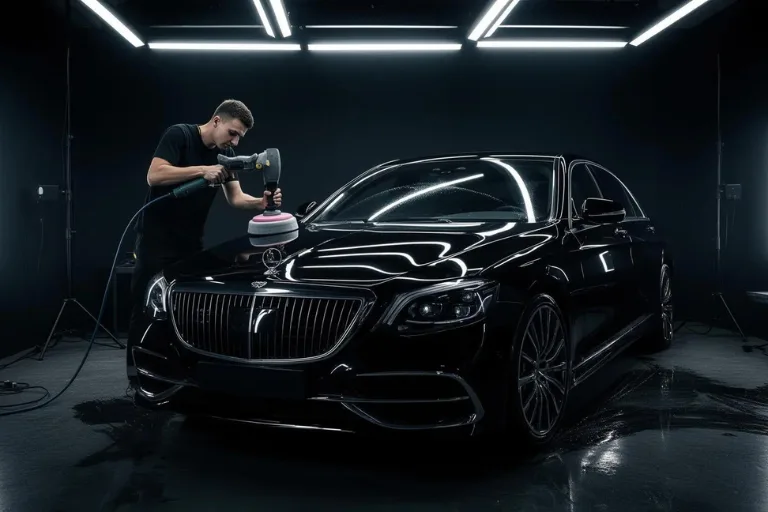
Professional detailing relies heavily on technical skills, including:
- Machine control
- Pad selection
- Product quantity
- Working temperature
- Surface inspection
- Finishing techniques
Experience allows technicians to maximize product performance while minimizing risks.
Standardized Processes Create Consistency
Customers expect consistent quality every time they visit a detailing studio.
This consistency is impossible without standardized operating procedures.
Professional detailing businesses often create step-by-step workflows covering every stage of service.
Typical workflow includes:
- Vehicle inspection
- Documentation
- Safe washing
- Decontamination
- Paint evaluation
- Paint correction
- Surface preparation
- Protection application
- Final inspection
- Customer handover
When every technician follows the same process, service quality remains consistent regardless of who performs the work.
Customer Experience Depends on Process Too
The detailing process doesn’t begin when polishing starts.
It begins the moment a customer contacts the business.
Professional customer processes include:
- Appointment scheduling
- Service consultation
- Transparent quotations
- Vehicle inspection reports
- Progress updates
- Before-and-after photos
- Delivery walkthrough
- Maintenance advice
These structured interactions build confidence and demonstrate professionalism long before customers see the finished vehicle.
Better Processes Reduce Mistakes
Many detailing mistakes occur because technicians rush or skip important steps.
Common problems include:
- Coating applied on contaminated paint
- Improper polishing techniques
- Missed defects
- Uneven coating coverage
- Water spots after delivery
- Residue left in panel gaps
A documented process acts as a quality checklist, ensuring that every stage is completed correctly before moving to the next.
Reducing errors not only saves time but also protects the business’s reputation.
Process Protects Business Profitability
A structured workflow benefits more than just vehicle quality—it also improves business performance.
Well-defined processes help businesses:
- Reduce rework
- Save labor hours
- Improve technician efficiency
- Increase customer satisfaction
- Lower warranty claims
- Deliver services on schedule
Instead of relying solely on individual talent, successful studios create systems that allow every team member to perform consistently.
Training Focuses on Process
Professional detailing training is not just about learning products.
Most advanced training programs emphasize:
- Vehicle inspection
- Surface preparation
- Paint correction methodology
- Safe chemical usage
- Equipment handling
- Customer communication
- Quality control
Technicians who understand the complete detailing workflow become more valuable than those who simply know how to apply products.
Premium Products Deliver Their Best Only with the Right Process
High-quality detailing products absolutely have their place.
Premium coatings often provide:
- Better gloss
- Greater durability
- Easier maintenance
- Enhanced chemical resistance
- Longer protection
However, these benefits can only be achieved when products are applied under the correct conditions.
Even the best ceramic coating cannot compensate for poor polishing or contaminated paint.
The process unlocks the full potential of every professional product.
Building Customer Trust Through Consistency
Customers rarely remember which brand of polishing compound or coating was used on their vehicle.
What they do remember is:
- The quality of the finish
- Professional communication
- Timely delivery
- Attention to detail
- Honest recommendations
- Overall experience
Consistent service builds long-term trust, referrals, and repeat business far more effectively than simply promoting expensive products.
The Future Belongs to Process-Driven Businesses
The automotive detailing industry continues to evolve with new coatings, advanced equipment, and innovative technologies.
Yet one principle remains unchanged.
Businesses that focus on:
- Standard operating procedures
- Technician training
- Continuous improvement
- Customer education
- Quality assurance
will consistently outperform competitors that rely only on premium products.
Professional systems create scalable businesses capable of delivering reliable results every single time.
Conclusion
In automotive detailing, products certainly matter—but process matters even more. The finest compounds, coatings, and equipment cannot replace proper preparation, skilled application, or a structured workflow. A professional detailing process ensures every vehicle receives the attention, precision, and care needed to achieve exceptional results.