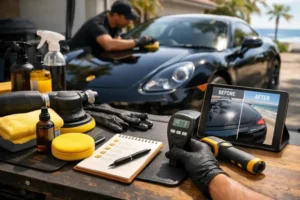

How Much Should a Professional Detailer Charge?
One of the most difficult questions for a professional detailing business is also one of the most important:
“What should I charge for my detailing services?”
There is no universal price that works for every detailing studio.
Two vehicles that appear similar from the outside can require completely different amounts of labour, products, equipment, preparation, and technical skill.
A small maintenance detail may take a few hours, while a heavily contaminated vehicle requiring paint correction and coating preparation can occupy a technician for an entire day or longer.
This is why professional detailing pricing should not be based simply on what competitors charge.
A sustainable pricing model should consider scope of work, vehicle condition, labour hours, materials, operating costs, technician expertise, equipment, customer expectations, and the required profit margin.
The goal is not simply to win the next customer.
It is to create a price that allows the business to deliver consistent quality while remaining financially sustainable.
-
Start With the Actual Service Scope
The first step in setting a price is defining exactly what the customer is receiving.
A detailing service may include:
- Exterior wash
- Interior cleaning
- Decontamination
- Paint enhancement
- Paint correction
- Ceramic coating
- PPF preparation
- Engine-bay cleaning
- Leather treatment
- Interior protection
- Maintenance detailing
These are not equivalent services.
A business should therefore avoid having one generic “detailing price” for every vehicle.
The quotation should clearly describe what is included.
-
Vehicle Size Matters
Vehicle size can affect the amount of work required.
A compact car may require significantly less:
- Shampoo
- Cleaning chemicals
- Towels
- Water
- Labour
- Working time
than a large SUV, luxury sedan, or commercial vehicle.
Many professional studios therefore structure pricing around vehicle categories such as:
- Small
- Sedan
- SUV
- Large SUV
- Luxury / specialist vehicle
The exact categories can be customized according to the business.
-
Vehicle Condition Is Even More Important
Size alone does not determine the workload.
Vehicle condition can have an even greater impact.
For example, a well-maintained vehicle may require relatively straightforward cleaning.
Another vehicle of the same size may have:
- Heavy dirt
- Pet hair
- Stains
- Water spots
- Tree sap
- Iron contamination
- Oxidation
- Swirl marks
- Scratches
The second vehicle may require significantly more labour.
This is why a professional detailer should ideally inspect the vehicle before providing a final quotation for complex services.
-
Calculate Labour Properly
Labour is one of the most important components of detailing pricing.
Suppose a service requires:
The business needs to understand the actual cost of those hours.
Labour cost is not simply the employee’s hourly wage.
The business may also have costs associated with:
- Training
- Payroll
- Insurance
- Employee benefits
- Non-billable time
- Cleaning and preparation
- Administrative work
A professional pricing model should account for the total productive labour cost.
-
Product Costs Need to Be Included
Every detailing service consumes products.
These may include:
- Shampoo
- APC
- Degreasers
- Iron remover
- Clay products
- Compounds
- Polishes
- Glass cleaners
- Interior cleaners
- Dressings
- Sealants
- Ceramic coatings
Even when the quantity used per vehicle is relatively small, the cumulative product cost can become significant.
Professional businesses should track product consumption rather than guessing.
-
Equipment Has a Cost
Professional detailing requires equipment.
Depending on the service, this may include:
- Pressure washers
- Vacuums
- Extractors
- Polishers
- Compressors
- Steam machines
- Lighting systems
- Air blowers
- Water filtration systems
Equipment needs to be purchased, maintained, repaired, and eventually replaced.
These costs should be reflected in the overall pricing structure.
-
Studio Overheads Matter
A detailing studio has operating costs even when no vehicle is being worked on.
These can include:
- Rent
- Electricity
- Water
- Internet
- Insurance
- Cleaning
- Software
- Marketing
- Salaries
- Maintenance
- Waste disposal
- Administrative expenses
If these costs are ignored, a business may generate revenue without generating enough profit.
Pricing should therefore contribute toward the studio’s fixed overheads.
-
Expertise Has Value
Professional detailing is not simply about applying products.
Experienced technicians understand:
- Paint behaviour
- Pad selection
- Machine control
- Compound selection
- Surface preparation
- Coating application
- Paint inspection
- Defect correction
The technician’s knowledge can significantly affect the quality and safety of the result.
A business that invests in training and technical expertise should not necessarily price its services like an inexperienced operator.
Customers are paying not only for products.
They are paying for time, skill, process, and outcome.
-
Paint Correction Should Not Be Priced Like a Basic Detail
Paint correction is particularly difficult to price using a simple fixed rate.
The required work depends on:
- Paint condition
- Defect severity
- Paint hardness
- Previous correction work
- Desired finish
- Number of correction stages
- Vehicle size
A one-step enhancement and a multi-stage correction are very different services.
Before quoting, the detailer should understand what level of correction is realistically required.
-
Ceramic Coating Pricing Should Include Preparation
Ceramic coating pricing should not be based simply on the cost of the coating bottle.
The service may involve:
- Wash
- Decontamination
- Clay treatment
- Paint inspection
- Paint correction
- Panel preparation
- Coating application
- Curing
- Final inspection
The coating itself may be only one component of the service.
If preparation is rushed, the coating may not deliver the expected result.
Professional pricing should therefore reflect the complete process.
-
Don’t Copy Competitor Prices Blindly
Looking at competitor prices can provide market context.
But copying them exactly can create problems.
Another detailing studio may have:
- Lower rent
- Different labour costs
- Higher volume
- Different equipment
- Lower product costs
- Different service quality
- Different target customers
Your business economics may be completely different.
Competitor pricing can be a reference point, but your own cost structure should determine whether a price is sustainable.
-
Understand Billable Hours
One of the most useful metrics for a detailing business is productive or billable time.
For example, if a technician works an eight-hour shift, it does not necessarily mean all eight hours can be sold to customers.
Time may also be spent on:
- Vehicle movement
- Setup
- Cleaning equipment
- Breaks
- Customer communication
- Stock management
- Studio maintenance
A business should understand how many technician hours are actually billable.
This makes pricing more realistic.
-
Create Service Packages
A clear service menu can make pricing easier for customers to understand.
For example:
Essential Detail
Basic cleaning and maintenance.
Enhancement Detail
Deeper cleaning with paint enhancement.
Correction Detail
Paint defect correction and finishing.
Protection Detail
Paint preparation followed by protective treatment.
Premium Detail
Comprehensive interior, exterior, correction, and protection services.
The exact services should be defined clearly.
Packages make it easier for customers to compare options without reducing every quotation to a single number.
-
Use Inspection-Based Pricing for Complex Jobs
For advanced services, fixed pricing may not always be appropriate.
An inspection-based quotation can consider:
- Vehicle size
- Vehicle condition
- Required labour
- Paint condition
- Existing coatings
- Contamination
- Desired outcome
- Service complexity
This approach protects both the customer and the detailing business.
The customer receives a more accurate estimate, while the detailer avoids underpricing difficult jobs.
-
Avoid Underpricing Just to Win Customers
Low prices can attract attention.
But consistently underpricing professional services can create problems.
The business may eventually struggle to afford:
- Better equipment
- Technician training
- Quality products
- Studio improvements
- Adequate staffing
If prices are too low, technicians may also feel pressure to complete jobs faster.
That can affect quality.
A professional business should therefore aim for a price that supports the required level of service.
-
Profitability Should Be Part of the Calculation
A simple pricing framework can be:
Direct Labour
Products
Equipment / Consumables
Overheads
Business Profit
Service Price
The exact percentages will vary between businesses.
The important principle is that every service should contribute appropriately toward both operating costs and profitability.
-
Customer Experience Also Has a Cost
Professional detailing includes more than the physical work.
A premium studio may provide:
- Professional consultation
- Digital quotations
- Vehicle inspection
- Before-and-after photographs
- Service documentation
- Customer updates
- Delivery inspection
- Maintenance recommendations
These activities require time.
If a business promises a premium customer experience, its pricing should account for the resources required to deliver that experience consistently.
A Practical Pricing Checklist
Before setting the price for any detailing service, ask:
-
How large is the vehicle?
-
What is its current condition?
-
How many labour hours are required?
-
Which products will be consumed?
-
What equipment will be used?
-
Are there special preparation requirements?
-
What level of technical skill is required?
-
What studio overheads need to be recovered?
-
What customer service is included?
-
What profit margin is required?
-
Are there potential risks or additional correction requirements?
This approach creates a more defensible and sustainable price.
What Customers Should Look For
Customers should also understand that the cheapest quotation is not necessarily comparable to a professional detailing quotation.
Before choosing a service, ask:
- What exactly is included?
- How many correction stages are planned?
- Which preparation steps are included?
- Which products are being used?
- How many technicians will work on the vehicle?
- How long will the service take?
- Is inspection included?
- What aftercare guidance is provided?
This makes price comparisons more meaningful.